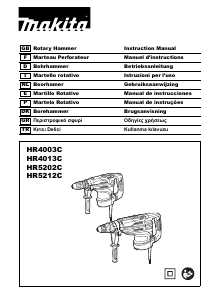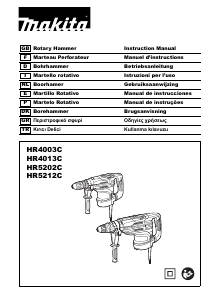
Manuale Makita HR4003C Martello perforatore

Hai bisogno di un manuale per il tuo Makita HR4003C Martello perforatore? Di seguito è possibile visualizzare e scaricare gratuitamente il manuale in PDF in italiano. Questo prodotto ha attualmente 4 domande frequenti, 0 commenti e ha 1 voto con una valutazione media del prodotto di 0/100. Se questo non è il manuale che desideri, contattaci.

Il tuo prodotto è difettoso e il manuale non fornisce alcuna soluzione? Rivolgiti a un Repair Café per il servizio di riparazione gratuita.

Manuale

Loading…
7
12. Do not point the tool at any one in the area when
operating. The bit could fly out and injure
someone seriously.
13. Do not touch the bit or parts close to the bit
immediately after operation; they may be
extremely hot and could burn your skin.
14. Some material contains chemicals which may be
toxic. Take caution to prevent dust inhalation
and skin contact. Follow material supplier safety
data.
SAVE THESE INSTRUCTIONS.
WARNING:
DO NOT let comfort or familiarity with product
(gained from repeated use) replace strict adherence
to safety rules for the subject product. MISUSE or
failure to follow the safety rules stated in this
instruction manual may cause serious personal
injury.
FUNCTIONAL DESCRIPTION
CAUTION:
Always be sure that the tool is switched off and
unplugged before adjusting or checking function on the
tool.
Switch action
CAUTION:
Before plugging in the tool, always check to see that
the switch trigger actuates properly and returns to the
“OFF” position when released.
Switch trigger (Fig. 1)
This switch functions when setting the tool in
symbol
and symbol modes.
To start the tool, simply pull the switch trigger. Release
the switch trigger to stop.
Switch button (Fig. 2)
This switch functions when setting the tool in symbol
mode.
When the tool is in the symbol mode, the switch
button projects out and lights in red.
To start the tool, press the switch button. The switch light
turns in green.
To stop the tool, press the switch button again.
Speed change (Fig. 3)
The revolutions and blows per minute can be adjusted
just by turning the adjusting dial. The dial is marked 1
(lowest speed) to 5 (full speed).
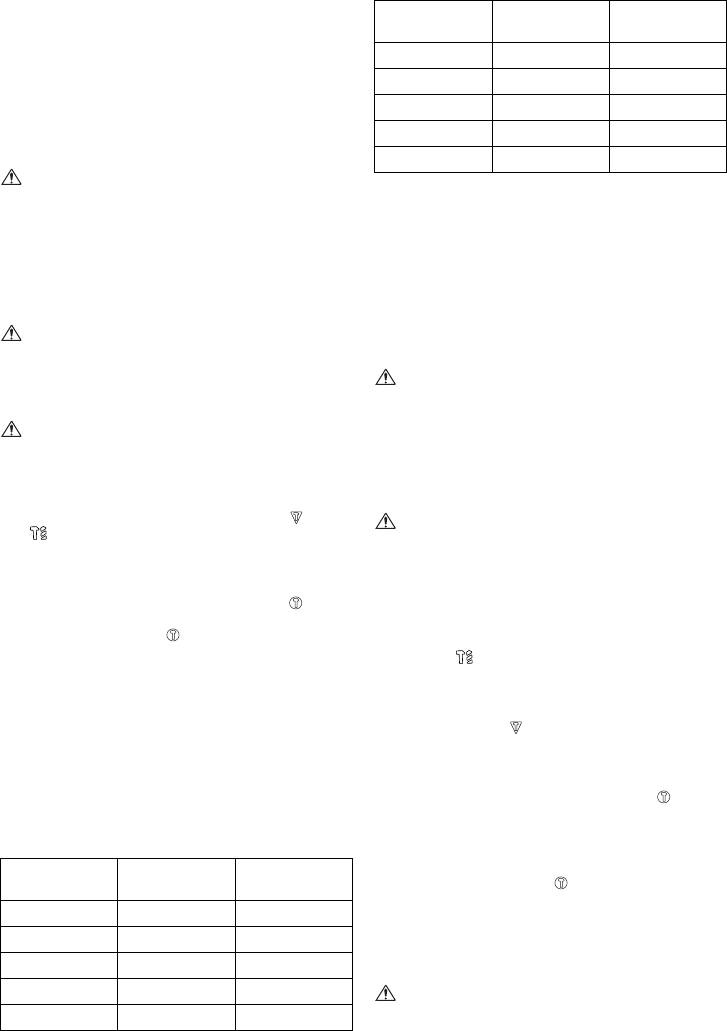
Refer to the table below for the relationship between the
number settings on the adjusting dial and the revolutions/
blows per minute.
For Model HR4003C, HR4013C
014134
For Model HR5202C, HR5212C
014872
For Model HR4013C, HR5212C only
NOTE:
Blows at no load per minute becomes smaller than
those on load in order to reduce vibration under no
load, but this does not show trouble. Once operation
starts with a bit against concrete, blows per minute
increase and get to the numbers as shown in the table.
When temperature is low and there is less fluidity in
grease, the tool may not have this function even with
the motor rotating.
CAUTION:
If the tool is operated continuously at low speeds for a
long time, the motor may get overloaded, resulting in
tool malfunction.
The speed adjusting dial can be turned only as far as 5
and back to 1. Do not force it past 5 or 1, or the speed
adjusting function may no longer work.
Selecting the action mode
CAUTION:
Do not rotate the change lever when the tool is running.
The tool will be damaged.
To avoid rapid wear on the mode change mechanism,
be sure that the change lever is always positively
located in one of the action mode positions.
Hammer drilling mode (Fig. 4)
For drilling in concrete, masonry, etc., rotate the change
lever to the symbol. Use a tungsten-carbide tipped
bit.
Hammering mode (Switch trigger mode) (Fig. 5)
For chipping, scaling or demolition operations, rotate the
change lever to the symbol. Use a bull point, cold
chisel, scaling chisel, etc.
Hammering mode (Switch button mode)
For continuous chipping, scaling or demolition
operations, rotate the change lever to the symbol.
(Fig. 6)
The switch button projects out and lights in red.
Use a bull point, cold chisel, scaling chisel, etc. (Fig. 7)
NOTE:
When using the tool in the symbol mode, the switch
trigger does not work but only the switch button works.
Torque limiter
The torque limiter actuates when torque reaches a
certain level. The motor disengages from the output
shaft. When this happens, the bit stops turning.
CAUTION:
As soon as the torque limiter actuates, switch off the
tool immediately. This helps to prevent premature wear
of the tool.
Number on
adjusting dial
Revolutions per
minute
Blows per
minute
5 500 2,900
4 470 2,700
3 380 2,150
2 290 1,650
1 250 1,450
Number on
adjusting dial
Revolutions per
minute
Blows per
minute
5 310 2,250
4 290 2,100
3 230 1,700
2 180 1,300
1 150 1,100
Scarica il manuale in italiano (PDF, 1.44 MB)
(Rispetta l’ambiente e stampa questo manuale solo se è veramente necessario)

Loading…

Valutazione

Facci sapere che cosa pensi della Makita HR4003C Martello perforatore valutando il prodotto. Vuoi condividere la tua esperienze con questo prodotto o porre una domanda? Ti preghiamo di lasciare un commento al fondo della pagina.
Sei soddisfatto di Makita HR4003C Martello perforatore?
No
0%
100%
1 vota

Partecipa alla conversazione su questo prodotto

Qui puoi condividere cosa pensi di Makita HR4003C Martello perforatore. Se hai una domanda, leggi prima attentamente il manuale. La richiesta di un manuale può essere effettuata utilizzando il nostro modulo di contatto.

Maggiori informazioni su questo manuale

Comprendiamo che sia bello avere un manuale cartaceo per i tuoi Makita HR4003C Martello perforatore. Puoi sempre scaricare il manuale dal nostro sito web e stamparlo tu stesso. Se desideri avere un manuale originale, ti consigliamo di contattare Makita. Potrebbero essere in grado di fornire un manuale originale. Stai cercando il manuale del tuo Makita HR4003C Martello perforatore in un'altra lingua? Scegli la tua lingua preferita sulla nostra home page e cerca il numero del modello per vedere se è disponibile.

Specifiche

Marca Makita
Modello HR4003C
Categoria Martelli perforatori
Tipo di file PDF
Dimensione del file 1.44 MB

Tutti i manuali per Makita Martelli perforatori
Altri manuali di Martelli perforatori

Domande frequenti su Makita HR4003C Martello perforatore

Il nostro team di supporto cerca informazioni utili sul prodotto e risposte alle domande più frequenti. Se trovi un’inesattezza nelle nostre domande frequenti, ti preghiamo di farcelo sapere utilizzando il nostro modulo di contatto.

Qual è la differenza tra un trapano a percussione e un martello perforatore? Verificato

I trapani a percussione possono essere utilizzati per effettuare fori nei muri di mattoni e a malta. Per effettuare fori in muri di cemento, è necessario un martello perforatore.

È stato utile (260) Per saperne di più

Cosa indicano i Joule (J) in relazione ai martelli rotanti? Verificato

Il numero di Joule è un’indicazione dell’impatto energetico del martello rotante. Per scavare fori regolari nel cemento, è sufficiente un martello rotante di 2,2 J.

È stato utile (219) Per saperne di più

Devo indossare una protezione per l'udito quando utilizzo un trapano? Verificato

Si, dovresti. Sebbene la quantità di rumore prodotta da un trapano possa variare a seconda della marca e del modello, l'esposizione a lungo termine a rumori forti può causare danni permanenti all'udito. Ecco perché è una buona idea indossare una protezione per l'udito.

È stato utile (138) Per saperne di più

Posso riporre gli utensili elettrici in un capannone o in un garage? Verificato

In generale, puoi riporre gli utensili elettrici in un capannone o in un garage, anche se a volte lì gela. Tuttavia, per garantire la durata di vita dell'elettroutensile, è meglio conservarlo in un luogo asciutto e senza forti sbalzi di temperatura. In un capannone o in un garage, le differenze di temperatura possono causare la formazione di condensa, che può causare ruggine. Inoltre, gli strumenti alimentati a batteria durano meno e non si caricano bene a temperature molto basse. Per essere sicuri di come riporre il vostro elettroutensile, leggete sempre attentamente il manuale dell'utente.

È stato utile (70) Per saperne di più
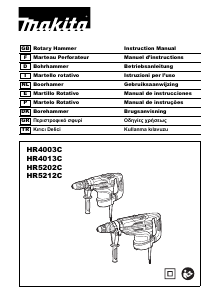
Manuale Makita HR4003C Martello perforatore

Prodotti correlati

Categorie correlate

×
Download