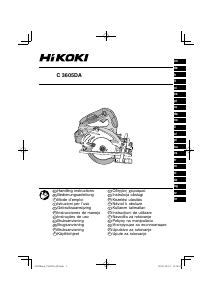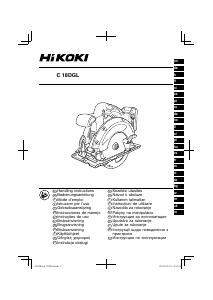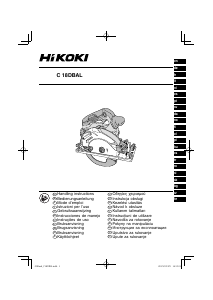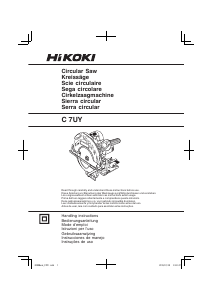
Manuale Hikoki C 6SS Sega circolare

Hai bisogno di un manuale per il tuo Hikoki C 6SS Sega circolare? Di seguito è possibile visualizzare e scaricare gratuitamente il manuale in PDF in italiano. Questo prodotto attualmente ha 3 domande frequenti, 0 commenti e ha 0 voti. Se questo non è il manuale che desideri, contattaci.

Il tuo prodotto è difettoso e il manuale non fornisce alcuna soluzione? Rivolgiti a un Repair Café per il servizio di riparazione gratuita.

Manuale

Loading…

3
English
5) Service
a) Have your power tool serviced by a quali ed
repair person using only identical replacement
parts.
This will ensure that the safety of the power tool is
maintained.
PRECAUTION
Keep children and in rm persons away.
When not in use, tools should be stored out of reach of
children and in rm persons.
SAFETY INSTRUCTIONS FOR ALL
SAWS
Cutting procedures
a)
DANGER: Keep hands away from cutting area
and the blade. Keep your second hand on auxiliary
handle, or motor housing.
If both hands are holding the saw, they cannot be cut by
the blade.
b) Do not reach underneath the workpiece.
The guard cannot protect you from the blade below the
workpiece.
c) Adjust the cutting depth to the thickness of the
workpiece.
Less than a full tooth of the blade teeth should be visible
below the workpiece.
d) Never hold the workpiece in your hands or across
your leg while cutting. Secure the workpiece to a
stable platform.
It is important to support the work properly to minimize
body exposure, blade binding, or loss of control.
e) Hold the power tool by insulated gripping surfaces,
when performing an operation where the cutting
tool may contact hidden wiring or its own cord.
Contact with a “live” wire will also make exposed metal
parts of the power tool “live” and could give the operator
an electric shock.
f) When ripping, always use a rip fence or straight
edge guide.
This improves the accuracy of cut and reduces the
chance of blade binding.
g) Always use blades with correct size and shape
(diamond versus round) of arbour holes.
Blades that do not match the mounting hardware of the
saw will run o -centre, causing loss of control.
h) Never use damaged or incorrect blade washers or
bolt.
The blade washers and bolt were specially designed
for your saw, for optimum performance and safety of
operation.
Kickback causes and related warnings
- kickback is a sudden reaction to a pinched, jammed or
misaligned saw blade, causing an uncontrolled saw to lift
up and out of the workpiece toward the operator;
- when the blade is pinched or jammed tightly by the kerf
closing down, the blade stalls and the motor reaction
drives the unit rapidly back toward the operator;
- if the blade becomes twisted or misaligned in the cut, the
teeth at the back edge of the blade can dig into the top
surface of the wood causing the blade to climb out of the
kerf and jump back toward the operator.
Kickback is the result of saw misuse and/or incorrect
operating procedures or conditions and can be avoided by
taking proper precautions as given below.
a) Maintain a rm grip with both hands on the saw
and position your arms to resist kickback forces.
Position your body to either side of the blade, but
not in line with the blade.
Kickback could cause the saw to jump backwards, but
kickback forces can be controlled by the operator, if
proper precautions are taken.
b) When blade is binding, or when interrupting a cut
for any reason, release the trigger and hold the saw
motionless in the material until the blade comes to
a complete stop.
Never attempt to remove the saw from the work or
pull the saw backward while the blade is in motion
or kickback may occur.
Investigate and take corrective actions to eliminate the
cause of blade binding.
c) When restarting a saw in the workpiece, centre the
saw blade in the kerf so that the saw teeth are not
engaged into the material.
If a saw blade binds, it may walk up or kickback from the
workpiece as the saw is restarted.
d) Support large panels to minimise the risk of blade
pinching and kickback.
Large panels tend to sag under their own weight.
Supports must be placed under the panel on both sides,
near the line of cut and near the edge of the panel.
e) Do not use dull or damaged blades.
Unsharpened or improperly set blades produce narrow
kerf causing excessive friction, blade binding and
kickback.
f) Blade depth and bevel adjusting locking levers
must be tight and secure before making the cut.
If blade adjustment shifts while cutting, it may cause
binding and kickback.
g) Use extra caution when sawing into existing walls
or other blind areas.
The protruding blade may cut objects that can cause
kickback.
Lower guard function
a) Check the lower guard for proper closing before
each use. Do not operate the saw if the lower guard
does not move freely and close instantly. Never
clamp or tie the lower guard into the open position.
If the saw is accidentally dropped, the lower guard may
be bent. Raise the lower guard with the retracting handle
and make sure it moves freely and does not touch the
blade or any other part, in all angles and depths of cut.
b) Check the operation of the lower guard spring. If
the guard and the spring are not operating properly,
they must be serviced before use.
Lower guard may operate sluggishly due to damaged
parts, gummy deposits, or a build-up of debris.
c) The lower guard may be retracted manually only for
special cuts such as “plunge cuts” and “compound
cuts”. Raise the lower guard by the retracting
handle and as soon as the blade enters the material,
the lower guard must be released.
For all other sawing, the lower guard should operate
automatically.
d) Always observe that the lower guard is covering
the blade before placing the saw down on bench or
oor.
An unprotected, coasting blade will cause the saw to
walk backwards, cutting whatever is in its path. Be aware
of the time it takes for the blade to stop after switch is
released.
ADDITIONAL SAFETY WARNINGS
1. Use only blade diameter speci ed on the machine.
2. Do not use any abrasive wheel.
3. Do not use saw blades which are deformed or cracked.
4. Do not use saw blades made of high speed steel.
5. Do not use saw blades which do not comply with the
characteristics speci ed in these instructions.
0000Book̲C6SS.indb30000Book̲C6SS.indb3 2019/02/1216:08:362019/02/1216:08:36
Scarica il manuale in italiano (PDF, 7.1 MB)
(Rispetta l’ambiente e stampa questo manuale solo se è veramente necessario)

Loading…

Valutazione

Facci sapere che cosa pensi della Hikoki C 6SS Sega circolare valutando il prodotto. Vuoi condividere la tua esperienze con questo prodotto o porre una domanda? Ti preghiamo di lasciare un commento al fondo della pagina.
Sei soddisfatto di Hikoki C 6SS Sega circolare?
No
Valuta per primo questo prodotto
0 voti

Partecipa alla conversazione su questo prodotto

Qui puoi condividere cosa pensi di Hikoki C 6SS Sega circolare. Se hai una domanda, leggi prima attentamente il manuale. La richiesta di un manuale può essere effettuata utilizzando il nostro modulo di contatto.

Maggiori informazioni su questo manuale

Comprendiamo che sia bello avere un manuale cartaceo per i tuoi Hikoki C 6SS Sega circolare. Puoi sempre scaricare il manuale dal nostro sito web e stamparlo tu stesso. Se desideri avere un manuale originale, ti consigliamo di contattare Hikoki. Potrebbero essere in grado di fornire un manuale originale. Stai cercando il manuale del tuo Hikoki C 6SS Sega circolare in un'altra lingua? Scegli la tua lingua preferita sulla nostra home page e cerca il numero del modello per vedere se è disponibile.

Specifiche

Marca Hikoki
Modello C 6SS
Categoria Sega circolari
Tipo di file PDF
Dimensione del file 7.1 MB

Tutti i manuali per Hikoki Sega circolari
Altri manuali di Sega circolari

Domande frequenti su Hikoki C 6SS Sega circolare

Il nostro team di supporto cerca informazioni utili sul prodotto e risposte alle domande più frequenti. Se trovi un’inesattezza nelle nostre domande frequenti, ti preghiamo di farcelo sapere utilizzando il nostro modulo di contatto.

A quanti millimetri sotto al materiale da segare deve arrivare la sega? Verificato

Si consiglia almeno di arrivare almeno a 3 mm. A una distanza minore, il materiale potrebbe sbriciolarsi o rovinarsi.

È stato utile (109) Per saperne di più

Devo indossare una protezione per l'udito quando uso una sega circolare? Verificato

Si, dovresti. Sebbene la quantità di rumore prodotta da una sega circolare possa variare a seconda delle marche e dei modelli, l'esposizione a lungo termine a rumori forti può causare danni permanenti all'udito. Ecco perché è una buona idea indossare una protezione per l'udito.

È stato utile (52) Per saperne di più

Posso riporre gli utensili elettrici in un capannone o in un garage? Verificato

In generale, puoi riporre gli utensili elettrici in un capannone o in un garage, anche se a volte lì gela. Tuttavia, per garantire la durata di vita dell'elettroutensile, è meglio conservarlo in un luogo asciutto e senza forti sbalzi di temperatura. In un capannone o in un garage, le differenze di temperatura possono causare la formazione di condensa, che può causare ruggine. Inoltre, gli strumenti alimentati a batteria durano meno e non si caricano bene a temperature molto basse. Per essere sicuri di come riporre il vostro elettroutensile, leggete sempre attentamente il manuale dell'utente.

È stato utile (26) Per saperne di più
Manuale Hikoki C 6SS Sega circolare

Prodotti correlati

Categorie correlate

×
Download