Manuale Haier DW12-CBE6 I Lavastoviglie

Hai bisogno di un manuale per il tuo Haier DW12-CBE6 I Lavastoviglie? Di seguito è possibile visualizzare e scaricare gratuitamente il manuale in PDF in italiano. Questo prodotto attualmente ha 11 domande frequenti, 0 commenti e ha 0 voti. Se questo non è il manuale che desideri, contattaci.

Il tuo prodotto è difettoso e il manuale non fornisce alcuna soluzione? Rivolgiti a un Repair Café per il servizio di riparazione gratuita.

Manuale

Loading…
Salt
Detergent and Rinse AidDetergent and Rinse Aid
Detergent and Rinse Aid
SaltSalt
SaltSalt
Salt
The hardness of the water varies from place to place. If hard
water is used in the dishwasher, deposits will form on the dishes
and utensils.
The appliance is equipped with a special softener that uses a salt
specifically designed to eliminate lime and minerals from the water.
Loading the Salt into the SoftenerLoading the Salt into the Softener
Loading the Salt into the Softener
Always use salt intended for use with dishwashers.
The salt container is located beneath the lower rack and should
be filled as follows:
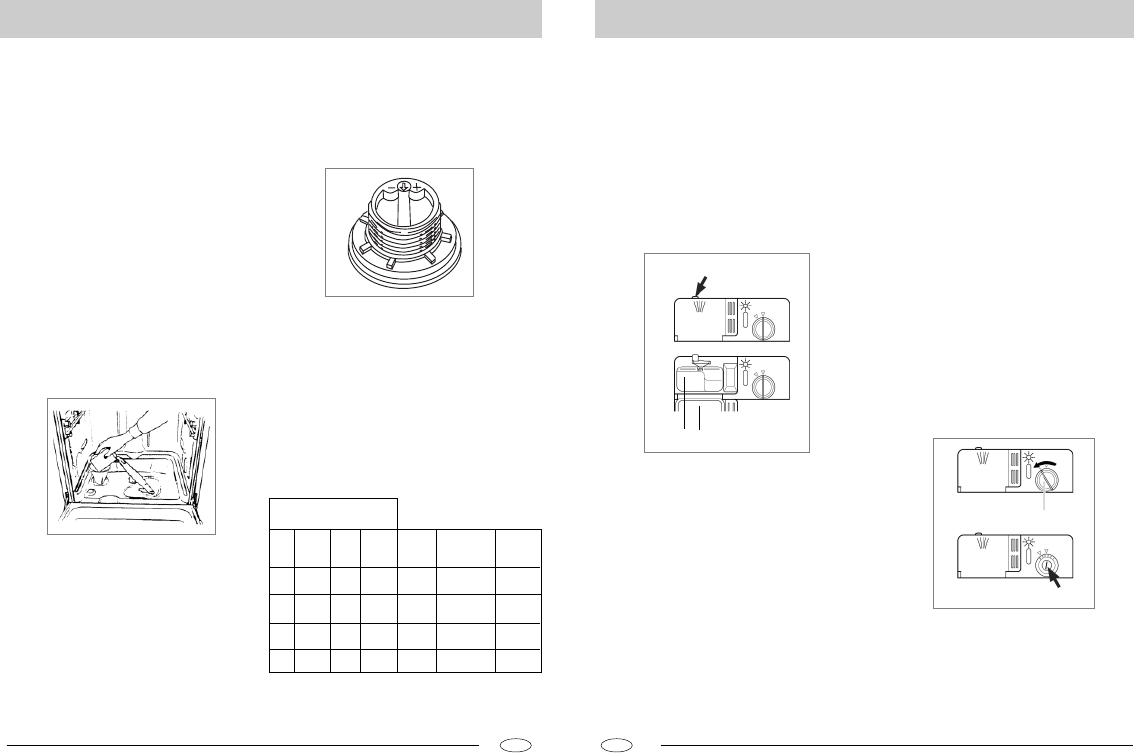
- Remove the lower rack and then unscrew and remove the cap
from the salt container;
- If you are filling the container for the first time, fill it with water;
- Place the end of the funnel (supplied) into the hole and intro-
duce about 2 kg of salt. It is normal for a small amount of water
to come out of the salt container.
- Carefully screw the cap back on.
The salt container must be filled when the "low salt" indicator
light (located on the control panel), comes on.
To prevent the formation of rust, load the salt just be-To prevent the formation of rust, load the salt just be-
To prevent the formation of rust, load the salt just be-
fore beginning a wash cycle.fore beginning a wash cycle.
fore beginning a wash cycle.
Adjusting Salt ConsumptionAdjusting Salt Consumption
Adjusting Salt Consumption
The dishwasher is designed to allow for adjusting the amount of
salt consumed based on the hardness of the water used. This is
intended to optimize and customize the level of salt consumption
so that it remains at a minimum.
To adjust salt consumption, proceed as follows:
- Unscrew the cap from the salt container;
- There is a ring on the container with an arrow on it (see figure to
the side),
- If necessary, rotate the ring in an anticlockwise direction from
the "-" setting towards the "+" sign, based on the hardness of
the water being used.
It is recommended that adjustments be made in accordance
with the following schema:
DetergentDetergent
DetergentDetergent
Detergent
Detergent specifically intended for use with dishwashers must
be used. The dispenser must be refilled before the start of each
wash cycle following the instructions provided in the "Wash Cycle
Table". The detergent dispenser is located on the inside panel
the door.
Loading the detergentLoading the detergent
Loading the detergent
To open the "A" cover on the dispenser, press the "B" button.
The detergent for the wash cycle should be poured into the "C"
compartment.
After the detergent has been placed in the dispenser, close the
cover and press down until it clicks in place.
Notice: To facilitate closing the cover, remove any ex-Notice: To facilitate closing the cover, remove any ex-
Notice: To facilitate closing the cover, remove any ex-
cess detergent on the edges of the dispenser.cess detergent on the edges of the dispenser.
cess detergent on the edges of the dispenser.
Rinse AidRinse Aid
Rinse AidRinse Aid
Rinse Aid
This product makes dishes sparkle and helps them to dry with-
out spotting. The dispenser is located on the inside panel of the
door and should be filled after every 80 wash cycles (or when
the "low rinse aid" indicator light comes on for those models
with this feature).
Loading the Rinse AidLoading the Rinse Aid
Loading the Rinse Aid
Regardless of the type of detergent dispenser installed on your
appliance, you must proceed as indicated below when loading
the rinse aid.
To open the dispenser, turn the "C" cap in an anti-clockwise
direction and then pour in the rinse aid, making sure not to overfill.
The amount of rinse aid used for each cycle can be regulated by
turning the "F" dose adjustor, located beneath the "C" cap, with
a screwdriver. There are 6 different settings; the normal dosage
setting is 3.
ImportantImportant
ImportantImportant
Important
Proper dosage of the rinse aid improves drying.Proper dosage of the rinse aid improves drying.
Proper dosage of the rinse aid improves drying.
If drops of water remain on the dishes or spotting occurs,If drops of water remain on the dishes or spotting occurs,
If drops of water remain on the dishes or spotting occurs,
the dosage adjustor should be turned to a higher setting.the dosage adjustor should be turned to a higher setting.
the dosage adjustor should be turned to a higher setting.
If the dishes have white streaks, turn the dosage adjustorIf the dishes have white streaks, turn the dosage adjustor
If the dishes have white streaks, turn the dosage adjustor
to a lower setting.to a lower setting.
to a lower setting.
Water HardnessWater Hardness
Water Hardness
Clarke
degrees
ºdH
mmol/l
Selector
position
Salt
consumption
(Grams/cycle)
Autonomy
(cycles/2kg)
014 017 0 1,7
1,8 4,418 4414 36
36 71 45 89 4,5 8,9
>89>71 >8,9
/
"-"
MED
/0
20
40
60"+"
60
40
25
Level
1
2
3
4
.4..4.
.4..4.
.4.
.3..3.
.3..3.
.3.
GBGB
GBGB
GB
GBGB
GBGB
GB
FF
FF
F
CC
CC
C
BB
BB
B
CC
CC
C
AA
AA
A
Scarica il manuale in italiano (PDF, 1.54 MB)
(Rispetta l’ambiente e stampa questo manuale solo se è veramente necessario)

Loading…

Valutazione

Facci sapere che cosa pensi della Haier DW12-CBE6 I Lavastoviglie valutando il prodotto. Vuoi condividere la tua esperienze con questo prodotto o porre una domanda? Ti preghiamo di lasciare un commento al fondo della pagina.
Sei soddisfatto di Haier DW12-CBE6 I Lavastoviglie?
No
Valuta per primo questo prodotto
0 voti

Partecipa alla conversazione su questo prodotto

Qui puoi condividere cosa pensi di Haier DW12-CBE6 I Lavastoviglie. Se hai una domanda, leggi prima attentamente il manuale. La richiesta di un manuale può essere effettuata utilizzando il nostro modulo di contatto.

Maggiori informazioni su questo manuale

Comprendiamo che sia bello avere un manuale cartaceo per i tuoi Haier DW12-CBE6 I Lavastoviglie. Puoi sempre scaricare il manuale dal nostro sito web e stamparlo tu stesso. Se desideri avere un manuale originale, ti consigliamo di contattare Haier. Potrebbero essere in grado di fornire un manuale originale. Stai cercando il manuale del tuo Haier DW12-CBE6 I Lavastoviglie in un'altra lingua? Scegli la tua lingua preferita sulla nostra home page e cerca il numero del modello per vedere se è disponibile.

Specifiche

Marca Haier
Modello DW12-CBE6 I
Categoria Lavastoviglii
Tipo di file PDF
Dimensione del file 1.54 MB

Tutti i manuali per Haier Lavastoviglii
Altri manuali di Lavastoviglii

Domande frequenti su Haier DW12-CBE6 I Lavastoviglie

Il nostro team di supporto cerca informazioni utili sul prodotto e risposte alle domande più frequenti. Se trovi un’inesattezza nelle nostre domande frequenti, ti preghiamo di farcelo sapere utilizzando il nostro modulo di contatto.

Dopo che la mia lavastoviglie ha terminato il ciclo di lavaggio, il contenitore delle pastiglie non si è aperto. Come mai? Verificato

Questo problema è spesso dovuto ai piatti che bloccano il contenitore, pertanto è necessario eseguire un controllo prima di avviare la lavastoviglie.

È stato utile (8378) Per saperne di più

Perché la lavastoviglie non scalda più l’acqua? Verificato

Il dispositivo di riscaldamento potrebbe essere difettoso e andrebbe sostituito. In caso di dubbi, si prega di contattare il produttore.

È stato utile (8167) Per saperne di più

Posso usare il sale normale nella mia lavastoviglie? Verificato

No, il sale normale può contenere sostanze che possono danneggiare l'elettrodomestico.

È stato utile (3474) Per saperne di più

Devo sciacquare i piatti prima di metterli in lavastoviglie? Verificato

Non è necessario sciacquare i piatti, ma bisogna rimuovere i resti grossi e duri, nonché i residui di grasso che potrebbero far intasare con il tempo lo scarico della lavastoviglie.

È stato utile (1430) Per saperne di più

Posso aprire la lavastoviglie mentre sta effettuando un ciclo di lavaggio? Verificato

La maggior parte delle lavastoviglie sono dotate di un sistema di interruzione dell’acqua, che arresta immediatamente il programma quando si apre lo sportello e che impedisce all’acqua di fuoriuscire. In alcuni modelli, questa pratica potrebbe provocare problemi nel tempo. In caso di lavastoviglie ad incasso, è possibile che l’apertura frequente dello sportello mentre è in azione possa danneggiare i mobili circostanti a causa del vapore che fuoriesce.

È stato utile (1216) Per saperne di più

Devo aprire la lavastoviglie alla fine del ciclo per far asciugare prima i piatti? Verificato

Dipende dal tipo di lavastoviglie e dalla sua posizione. Alcune lavastoviglie sono dotate di una funzione di asciugatura al termine del ciclo di lavaggio. In questo caso, aprire lo sportello della lavastoviglie non serve a niente. In caso di lavastoviglie ad incasso, è possibile che l’apertura frequente dello sportello mentre è in azione possa danneggiare i mobili circostanti a causa del vapore che fuoriesce.

È stato utile (973) Per saperne di più

Una volta terminato il ciclo di lavaggio della lavastoviglie, i piatti di plastica sono ancora bagnati mentre il resto è asciutto. A cosa può essere dovuto? Verificato

La plastica non è un buon conduttore di calore e consente ai prodotti di raffreddarsi velocemente. L’umidità rimanente evapora quindi molto meno rispetto alla ceramica o ai metalli.

È stato utile (870) Per saperne di più

Posso collegare la lavastoviglie a una prolunga? Verificato

Gli elettrodomestici che necessitano di molta energia, come le lavastoviglie, non possono essere collegati con una prolunga. Verificare il consumo energetico della lavastoviglie, indicato in Watt, e controllare che la prolunga possa reggerlo. Esistono delle prolunghe con cavi più spessi che sono costruiti per reggere elettrodomestici più potenti.

È stato utile (816) Per saperne di più

Posso mettere pentole con teflon in lavastoviglie? Verificato

Si, puoi. Tuttavia, la padella si consumerà più velocemente rispetto a quando viene pulita a mano. Quando si pulisce a mano una padella con teflon, non utilizzare mai una paglietta ma utilizzare una spugna o un panno morbido.

È stato utile (814) Per saperne di più

Posso mettere oggetti in legno come spatole e taglieri in lavastoviglie? Verificato

No. Gli oggetti in legno possono danneggiarsi o deformarsi in lavastoviglie. Inoltre, le fibre di legno che si liberano potrebbero danneggiare la lavastoviglie. I taglieri in legno sono spesso realizzati con colla che può staccarsi dopo essere stata lavata più volte in lavastoviglie.

È stato utile (812) Per saperne di più

È un problema avere graffi sul metallo all'interno della lavastoviglie? Verificato

L'interno della maggior parte delle lavastoviglie è realizzato in acciaio inossidabile e non è soggetto a graffi.

È stato utile (811) Per saperne di più
Manuale Haier DW12-CBE6 I Lavastoviglie

Prodotti correlati

Categorie correlate

×
Download