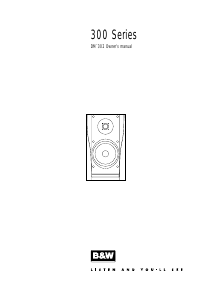
Manuale Bowers and Wilkins DM302 Altoparlante

Hai bisogno di un manuale per il tuo Bowers and Wilkins DM302 Altoparlante? Di seguito è possibile visualizzare e scaricare gratuitamente il manuale in PDF in italiano. Questo prodotto attualmente ha 5 domande frequenti, 0 commenti e ha 0 voti. Se questo non è il manuale che desideri, contattaci.

Il tuo prodotto è difettoso e il manuale non fornisce alcuna soluzione? Rivolgiti a un Repair Café per il servizio di riparazione gratuita.

Manuale

Loading…

1
INTRODUCTION
Thank you for purchasing B&W DM300 Series
speakers.
Since its foundation in 1966, the continuing
philosophy of B&W has been the quest for
perfect sound reproduction. Inspired by the
companys founder, the late John Bowers, this
quest has entailed not only high investment in
audio technology and innovation but also an
abiding appreciation of music to ensure that the
technology is put to maximum effect.
It is also our policy to make sure the advanced
features pioneered on one product are
incorporated into others we manufacture.
The rear panel of the DM302 cabinet is
formed into a wedge pattern similar to the
interior of an anechoic chamber. This greatly
helps to break up the regular internal cabinet
volume that would otherwise encourage
coloration from internal standing waves.
Homogeneous fibre cone bass/midrange
drive units are used for minimum coloration
and maximum definition. The DM302 also
features a soft dome tweeter with magnetic
fluid cooling to ensure good definition to the
limits of audibility and maintain dynamics to
high sound levels.
However, no matter how good the speakers
themselves, they must work well into the listening
room and time spent on the installation process
will reap the reward of many hours listening
pleasure. Please read through this manual fully.
It will help you optimise the performance of your
audio system.
B&W distribute to over 50 countries world-wide
and maintain a network of dedicated distributors
who will be able to help should you have any
problems your dealer cannot resolve.
UNPACKING
(figure 1)
Fold the top carton flaps right back and
invert the carton and contents.
Lift the carton clear of the contents.
Remove the inner packing from the product.
We suggest you retain the packaging for
future use.
CONNECTIONS
(figure 2)
All connections should be made with the
equipment turned off.
Connect the positive terminal on the speaker
(marked + and coloured red) to the positive
terminal on the power amplifier and negative
(-, black) to negative (figure 2). Failure to
observe correct polarity will result in poor
sound balance and image focusing.
Always make sure all the terminal caps are
screwed down tight, as otherwise they
may rattle.
When choosing cable, keep the total electrical
impedance (out and back) below the maximum
recommended in the specification. In particular,
the cable to the tweeter should have low
inductance, otherwise the very high frequencies
will be attenuated. Ask your dealer for advice,
as the optimum cable will depend on the length
required.
POSITIONING
(figure 3)
Some experimentation with the position of the
speakers is well worthwhile to optimise the
interaction between them and the listening room.
However, as an initial guide:
Place the speakers on firm stands or bookshelves
that place the tweeters approximately at ear
level.
Place the speakers and the centre of the listening
area approximately at the corners of an
equilateral triangle.
Keep the speakers at least 1.5m (5ft) apart to
maintain left-right stereo separation.
Keep the speaker baffles at least 0.5m (20in)
clear of walls. Having the speakers too close to
walls increases the level of bass relative to the
midrange and may give a boomy quality to the
sound.
NOTE: The DM302 produces a static
magnetic field that extends outside the cabinet
boundary. As such The DM302 should not be
placed within 0.5m (20in) of equipment that
may be affected by such a field, e.g. Cathode
Ray Tubes in TVs and Personal Computers.
FINE TUNING
Before fine tuning the installation, double check
the polarity and security of the connections.
If the level of bass is uneven with frequency, this
is usually due to strong excitation of resonance
modes in the room.
Even small changes in the position of the
speakers within the listening room can have a
profound effect on the perceived sound quality
by altering the excitation of these modes. Try
mounting the speakers along a different wall.
Even moving large pieces of furniture about can
have an effect.
If the general level of bass is too high, try
moving the speakers further away from the walls.
Conversely, if you need more bass, move the
speakers closer to the walls. Space behind the
speakers also improves the impression of
perspective on well recorded material.
If the central image is poor, try moving the
speakers closer together or toeing them in so
they point at or just in front of the listening area
(figure 4).
If the sound is too harsh, increase the amount of
soft furnishing in the room. For example, use
heavier curtains. Conversely reduce the amount
of soft furnishing if the sound is dull and lifeless.
Test for flutter echoes by clapping your hands
and listening for rapid repetitions. These can
smear the sound, but may be reduced by
irregular shaped surfaces such as bookshelves
and large pieces of furniture.
Ensure the speakers are firmly supported.
Speaker stands should be regarded as part of
the speaker and chosen with care. Ask your
dealer for advice on the best stands for your
needs.
AFTERCARE
The vinyl veneers normally only require dusting.
If you wish to use an aerosol cleaner, remove
the grille first by gently pulling it away from the
cabinet. Spray onto the cleaning cloth, not
directly onto the cabinet. The grille fabric may
be cleaned with a normal clothes brush after
removing the grille from the cabinet.
Avoid touching the drive units, especially the
tweeter, as damage may result.
Scarica il manuale in italiano (PDF, 0.08 MB)
(Rispetta l’ambiente e stampa questo manuale solo se è veramente necessario)

Loading…

Valutazione

Facci sapere che cosa pensi della Bowers and Wilkins DM302 Altoparlante valutando il prodotto. Vuoi condividere la tua esperienze con questo prodotto o porre una domanda? Ti preghiamo di lasciare un commento al fondo della pagina.
Sei soddisfatto di Bowers and Wilkins DM302 Altoparlante?
No
Valuta per primo questo prodotto
0 voti

Partecipa alla conversazione su questo prodotto

Qui puoi condividere cosa pensi di Bowers and Wilkins DM302 Altoparlante. Se hai una domanda, leggi prima attentamente il manuale. La richiesta di un manuale può essere effettuata utilizzando il nostro modulo di contatto.

Maggiori informazioni su questo manuale

Comprendiamo che sia bello avere un manuale cartaceo per i tuoi Bowers and Wilkins DM302 Altoparlante. Puoi sempre scaricare il manuale dal nostro sito web e stamparlo tu stesso. Se desideri avere un manuale originale, ti consigliamo di contattare Bowers and Wilkins. Potrebbero essere in grado di fornire un manuale originale. Stai cercando il manuale del tuo Bowers and Wilkins DM302 Altoparlante in un'altra lingua? Scegli la tua lingua preferita sulla nostra home page e cerca il numero del modello per vedere se è disponibile.

Specifiche

Marca Bowers and Wilkins
Modello DM302
Categoria Altoparlanti
Tipo di file PDF
Dimensione del file 0.08 MB

Tutti i manuali per Bowers and Wilkins Altoparlanti
Altri manuali di Altoparlanti

Domande frequenti su Bowers and Wilkins DM302 Altoparlante

Il nostro team di supporto cerca informazioni utili sul prodotto e risposte alle domande più frequenti. Se trovi un’inesattezza nelle nostre domande frequenti, ti preghiamo di farcelo sapere utilizzando il nostro modulo di contatto.

Quale porta devo utilizzare se voglio collegare una cassa al televisore tramite HDMI? Verificato

Utilizzare la porta HDMI-ARC, appositamente pensata per collegare i dispositivi audio.

È stato utile (1486) Per saperne di più

Cosa indicano le frequenze riferite al mio altoparlante? Verificato

Indica la gamma di frequenze che l'altoparlante può produrre. Una gamma più alta di frequenze fornirà una variazione più ampia del suono e il suono sarà di qualità migliore.

È stato utile (794) Per saperne di più

Quando il volume della musica è troppo alto? Verificato

Il suono superiore a 80 decibel (dB) può iniziare a danneggiare l’udito. Il suono superiore a 120 dB lo danneggia immediatamente. La gravità del danno è correlata alla frequenza e alla durata del suono.

È stato utile (475) Per saperne di più

Il segnale Bluetooth passa attraverso muri e soffitti? Verificato

Sì, il segnale Bluetooth passa attraverso muri e soffitti, a meno che non siano fatti di metallo. A seconda dello spessore e del materiale dei muri, il segnale potrebbe indebolirsi.

È stato utile (236) Per saperne di più

Qual è la soglia massima di rumore sicura per i bambini? Verificato

L’udito dei bambini è più sensibile di quello degli adulti. Si consiglia pertanto di non esporre i bambini a rumori più alti di 85 dB. Esistono modelli speciali di auricolari appositi per bambini. In caso di altoparlanti o altre situazioni, si consiglia di fare attenzione che il rumore non superi quella soglia.

È stato utile (212) Per saperne di più

Manuale Bowers and Wilkins DM302 Altoparlante

Prodotti correlati

Categorie correlate

×
Download